Monday, 16 January 2017

Day 6

Before Class
After watching the required video 'The Essence of Connected Learning' fill out the following form with your responses to show your understanding of the topics within it. 
http://tinyurl.com/ResponsestoEofCL
Responses can be found on this spreadsheet
We will watch the 'Why connected learning' video in class. The 'Whanau' concept of knowledge that underpins Maori understandings of human development and learning includes a sense of belonging and and relating to others within the context of collective identity and responsibility.
This week we'll work around two ideas, Connected Learning and Connectivism that are trying to grasp those issues.
Connected Learning and Connectivism
If “Connected learning is about much more than plugging youth into technology.” Then what is connected learning?
Due to the rapid change and technological advancement, the demands and opportunities placed on our students are greater than ever. Constantly changing networks (personal, social, and work) challenge students to process, learn, and respond to torrents of new information and new technologies. Learning is no longer framed by restrictions of time and place. Knowledge is now available everywhere, 24 hours a day so new models of education need to recognise learning as a constant with delivery modes and learning times as the variables.
New education models are needed to expand learning beyond the school through connected networks that bring education opportunities together into a seamless, integrated experience. In 2016 there is no reason why the abundance of resources and knowledge on the internet should be contained within a physical classroom, and there is little reason why a student should be confined to only taking courses offered by their school.
The notion of ensuring interchange and integration of learning networks and of the resources should underpin the construction of new education models. Connected learning and connectivism are two complementary views of the power of the network in 21st century learning
In Class Activities
While doing the in-class collaborative task 'How could the learning of your students be more social, participatory, interest-driven and relevant to the opportunities of our time' use the following links. 
Six Principles of Connected Learning - hover your cursor over the picture on the web site (matching the one below) for interactive pop up descriptors. 
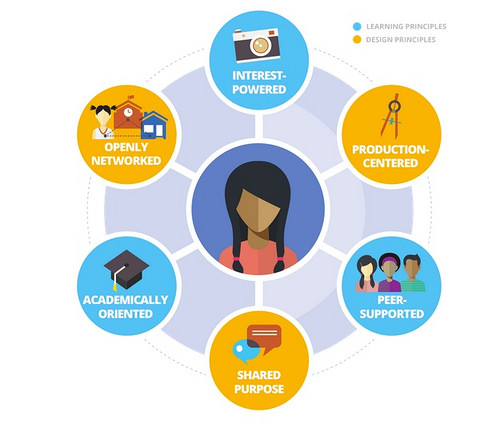
We will then view 'Dr George Siemens on connectivism' - and his perspective on where connectivism came from and what it means.
References:
Connected Learning Alliance. (n.d). Why Connected Learning. Retrieved from http://clalliance.org/why-connected-learning/
DML Research Hub. (2012). Connected Learning: Interest, Peer Culture, Academics. Retrieved from https://www.youtube.com/watch?v=zFdzz26g-EE
DML Research Hub. (2014). Why Connected Learning. Retrieved from: https://www.youtube.com/watch?v=mFBqOgCssZI

University of the Sunshine Coast, Queensland, Australia. (August 2013). Overview of connectivism - Dr George Siemens. Retrieved from https://www.youtube.com/watch?v=yx5VHpaW8sQ
Leadership Theories
As time has progressed a number of leadership theories have emerged which deal with various styles and methodologies about leadership. These theories could be labelled in four broad headings; namely the Trait theories, Behavioral theories, Contingency theories and the Power and Influence theories. In 1922, Max Weber (see Weber, 1978) identified three kinds of leader/follower relations; traditional, bureaucratic and charismatic. He also noted that they occur in combination, and there may be gradual transitions between these types. Since then, much has been written about types of leadership. Some examples of leadership theories relevant to education include
  • Servant Leadership
  • Pedagogical Leadership
  • Transactional Leadership
  • Transformational Leadership
  • Maori Leadership
Burns (1978) outlined the original ideas for both transactional and transformational leadership. He stated that both are 'moral' forms of leadership, as opposed to 'amoral' power-wielding.
Bass & Riggio (2006) developed their transformational leadership theory based on Burns' original ideas. This has been the one many of our students have found interesting to reflect upon in their Leadership 1 assessments. According to this theory, transformational leadership can be defined based on the impact that it has on followers. 
Providing a different perspective, Tū Rangatira: Māori Medium Educational Leadership (Ministry of Education, 2010) presents a model of leadership that reflects some of the key leadership roles and practices that contribute to high-quality educational outcomes for Māori learners. It focuses on leadership practices, providing insights into how effective professional development programmes can work towards strengthening leaders’ capabilities, growing capacity and sustaining exemplary leadership in the Māori medium education sector.
Leadership Styles
During this week's lesson we'll also introduce some views on different leadership styles. Keep in mind that the styles are often drawn from the theories, so from your assessment point of view get your justifications from the theories and link them to the styles you used. 
Complete the University of Kent online quiz about your typical leadership styles When you have finished record your results and thoughts for later use (Leadership 1 & 2 Assessments).
Based on a three-year study of over 3,000 executives, Goleman, Boyatzis & McKee (2013) identified six different leadership styles
  • Pace-setting leaders expect excellence and self-direction, and can be summed up as ‘Do as I do, now’. The Pace-setter very much leads by example, but this type of leadership only works with a highly-competent and well-motivated team.
  • Authoritative leaders move people towards a vision, so are often described as ‘Visionary’. This style is probably best summed up as ‘Come with me’. It is the most useful style when a new vision or clear direction is needed, and is most strongly positive.
  • An Affiliative leader values and creates emotional bonds and harmony, believing that ‘People come first’. Such leaders demonstrate empathy, and strong communication skills, and are very good at building relationships. This style is most useful when a team has been through a difficult experience, and needs to heal rifts, or develop motivation.
  • The democratic leader builds consensus through participation, constantly asking ‘What do you think?’, and showing high levels of collaboration, team leadership and strong communication skills. This style of leadership works well in developing ownership for a project, but it can make for slow progress towards goals, until a certain amount of momentum has built up.
  • coaching leader will develop people, allowing them to try different approaches in an open way. The phrase that sums up this style is ‘Try it’, and this leader shows high levels of empathy, self-awareness and skills in developing others. A coaching style is especially useful when an organisation values long-term staff development
  • Coercive leaders demand immediate obedience. In a single phrase, this style is ‘Do what I tell you’. These leaders show initiative, self-control, and drive to succeed. There is, of course, a time and a place for such leadership: a battlefield is the classic example, but any crisis will need clear, calm, commanding leadership.
Leadership Attributes
There are many personal characteristics that may be identified as aspects of leadership. However it may be helpful to explore some of the attributes identified within various categories that we have introduced on the course previously. These include:
  • Key Competencies (e.g. relating to others)
  • 21st Century Skills (e.g. real-world problem-solving and innovation)
  • Growth Mindset (e.g. resilience)
  • Adaptive Competence (e.g cultural awareness)
  • Emotional intelligence (e.g. social skill) 
  • World Economic Forum (2015) character qualities (e.g. initiative)
Google Training and Emotional Intelligence
Google freely share their New Manager Training Guide, which includes some coverage of the importance of emotional intelligence, including the attributes of sympathy, empathy and compassion.
In the session we will watch a clip by Brené Brown about emotional intelligence and briefly discuss the difference between sympathy, empathy and compassion.
References
Bass, B.M. & Riggio, R.E. (2006). Transformational Leadership (Second Edition), Routledge
Brown, R. (2013). Brené Brown on Empathy. Retrieved from https://www.youtube.com/watch?v=1Evwgu369Jw
Burns, J.M. (1978). Leadership. New York, NY: Harper & Row
Goleman , D., Boyatzis, R. & McKee, A. (2013). Primal Leadership: Realizing the Power of Emotional Intelligence. Boston, MA: Harvard Business Review Press.
Ministry of Education. (2010). Tū Rangatira: Māori Medium Educational Leadership. Retrieved from http://www.educationalleaders.govt.nz/Leadership-development/Key-leadership-documents/Tu-rangatira-English
University of Kent. (2011). How to find out your style of leadership. Retrieved from https://www.kent.ac.uk/careers/sk/leadership.htm
Weber, M. (1978). Economy and Society: An outline of interpretive sociology. Berkeley, CA: University of California Press.
World Economic Forum. (2015). The skills needed in the 21st century. New Vision for Education - Unlocking the Potential of Technology. Retrieved from https://widgets.weforum.org/nve-2015/chapter1.html
(Note: Full version of the report available from http://www3.weforum.org/docs/WEFUSA_NewVisionforEducation_Report2015.pdf)
Leadership

Variety of Leadership roles - in class middle snr


10 Theories
1. Great man theory -
2 The trait theory - dozens overwhelming
3. Skills theory - tech skills be good at what u do people skills conceptual skills big pic
4 Style theory - Managerial grid
5 Situational - no one style leader must adapt according to situation
6 Contingency - right leader to situation match leader to setting change leader
7 Transactional - bribing or punishing
8 Transformational - encouraging inspiring
9 exchange - lower performance and retention
10 servant -  find need and help serve rather than being served creates trust follow out of gratitude

Tu Rangatira Maori Medium Leadership
Pacifica


Theories styles and attributes are important to be successful. (see portal)

Daniel Goleman - importance of attributes - Emotional intelligence
Emotional intelligence universal - looks different in different places.


https://www.youtube.com/watch?v=1Evwgu369Jw


Digital

https://app.themindlab.com/media/19772/view

Social connectivity
Real world engagement

Connectivism - https://app.themindlab.com/media/19771/view


Day 7

Blended Learning
The definition of blended learning is a formal education program in which a student learns: (1) at least in part through online learning, with some element of student control over time, place, path, and/or pace; (2) at least in part in a supervised brick-and-mortar location away from home; (3) and the modalities along each student’s learning path within a course or subject are connected to provide an integrated learning experience.
Blended Models (see http://tinyurl.com/tmlblended)
These blended learning models come from the Clayton Christensen Institute
  • Rotation model 
    • Station Rotation
    • Lab Rotation
    • Flipped Classroom
    • Individual Rotation 
  • Flex model
  • A La Carte model
  • Enriched Virtual model
Flipped Classroom
The idea of the flipped classroom as first developed in 2007 by Bergmann & Sams (2012), who describe their experience in their book "Flip Your Classroom: Reach Every Student in Every Class Every Day". The idea behind a flipped model of education is that much of the content is covered outside of the classroom through bite sized (under 10 minute) video clips, quizzes and collaborative discussions. Subsequently deeper learning can occur in the classroom through face to face discussion which can apply, evaluate and contextualise the content as well as enhancing collaborative activities, strengthening relationships, developing communication skills and other key competencies. The pedagogical approach has to be adapted and the mode of teaching must change to a more student orientated practice as the content (often teacher led) part of the session has already been covered. A flipped method fits in extremely well with many different learning areas but particularly links well and supports active learning experiences; more time for hands on learning and less time stuck in the classroom.
One interesting approach suggested by Schell (2013) is that it is best not to t tell students you are “flipping” or “experimenting” since they might be resistant to the idea. Instead, just go ahead and do it (stealth flip'). She also suggests that just flipping the classroom is not enough; you probably also need to rethink your assessment practice.
In-Class Flipping (See http://tinyurl.com/tmlflip)
Besides the fact that it avoids the home-related problems of a traditional flip, the In-Class Flip has other advantages as well:
  • The teacher can observe whether students are really watching. 
  • The initial exposure to the video content has a better chance to sink in.
  • Hardware is (presumably) safer. 
In-Class Flipping is not without its own challenges:
  • It doesn't make for tidy one-period lesson plans. 
  • More preparation is required at the beginning. .
  • Technically, you don’t "gain" more class time.
Tools for Creating Content for Flipped or Blended Lessons
EdPuzzle
A simple tool to add content to existing videos. Can use video content from multiple sources within the site, or upload your own video. It’s also easy to “crop” videos so you are only showing the section of the video you want students to watch instead of the whole thing. Insert questions anywhere in the video you want and have multiple choice questions automatically graded. Teacher view shows you which students have watched the video and how they fared on the questions. https://edpuzzle.com/
TED-Ed
TED-Ed is TED’s youth and education initiative. Using any video on TED-Ed, TED Talks or  YouTube, teachers can create and customize lessons for their students. There are four elements, Watch, Think, (teachers can create multiple choice or short answer questions), Dig Deeper, (provide more information), and Discuss (prompts for online discussions). http://ed.ted.com/lessons
BlendSpace
Blendspace is an easy-to-use platform for creating multimedia lessons that can be accessed online. Using a drag-and-drop interface, can organize videos, text, links, images, and quizzes into cubes, then organize them to create lessons, or "canvases, " for your students to complete independently. https://www.tes.com/lessons
References
Bergmann, J. & Sams, A. (2012). Flip Your Classroom: Reach Every Student in Every Class Every Day. Washington, DC: International Society for Technology in Education. https://books.google.co.nz/books?isbn=1564844684
Gudenrath, A. (2013). Flipping your classroom to meet the common core and other standards.http://blog.peerinstruction.net/2013/08/19/flipping-your-classroom-to-meet-the-common-core-and-other-standards/
Hamdan, N., McKnight, P., McKnight, C., & Arfstrom, K. (2013). A review of flipped learning. Upper Saddle River, New Jersey: Pearson. http://www.flippedlearning.org
Raths, D. (2013, December 4). 9 Video Tips for a Better Flipped Classroom. Retrieved March 29, 2016, from https://thejournal.com/Articles/2013/11/18/9-Video...
Schell, J. (2013). The 2 most powerful flipped classroom tips I have learned so far. http://blog.peerinstruction.net/2013/04/16/the-2-most-powerful-flipped-classroom-tips-i-have-learned-so-far/
Westermann E.B. (2014). A Half-Flipped Classroom or an Alternative Approach? Primary Sources and Blended Learning. Educational Research Quarterly 38(2), 43–57.

Before: Log in as a student to EDpuzzle by using this link http://tinyurl.com/TMLEDpuzzle - do the homework viewing you will be directed to (you will have to use that specific link to access the right class task)
Online and Distributed Leadership
When leading students through new or unfamiliar online learning environments it is important for the teacher to establish a strong social presence so that they feel a similar sense of community and group cohesion.
Digital Citizenship/Cybersafety
How often do we teach students about digital citizenship or cybersafety? 
Netsafe NZ describe the qualities needed to be a successful digital citizen and the importance of Digital Literacy. Netsafe What is a 'Digital Citizen'?
Leading Online Discussions (MindEdge Learning Workshop, 2014).
  • Set guidelines
  • Make connections
  • Challenge students to think critically
  • Encourage participation
  • Praise discussion posts
  • Guide conversations back to the question at hand
  • Use real world experiences
  • Hesitate before interjecting
Why Use Twitter
  • Encourages brevity
  • Identifies the tweeter
  • Allows replies and hashtags
  • Integrates with other tools (e.g. Tagboard, Pocket, Buffer, feedly)
  • Supports weblinks
  • Mobile App available
Twitter Terminology 101 (Saimond, 2009)
  • Tweet
  • Follower
  • # (hashtag, precedes a topic)
  • @ (precedes a Twitter user name you are referring to)
  • Retweet (RT)
  • Modified Tweet (MT)
  • Hat Tip (HT)
  • Reply
  • Direct Message (DM)
Mind Lab Twitter
Handle: #NZMindLab
Hashtag: #mindlabED
Some Twitter Tweeters and NZ education hashtags
@EducationGovtNZ @netsafeNZ
#edchatNZ (See: http://www.edchatnz.com/getting-started) #kidsedchatNZ #engchatNZ #mathschatNZ #scichatNZ #hackyrclass
Twitter Tips for Teachers
Education Review (2013) suggests ten ways that New Zealand teachers can get more out of the Twitterverse. We think these 6 are the most useful.
  • Use TweetDeck to manage your Twitter feeds.
  • Choose hashtags carefully and check for duplicates already being used
  • Join the #edchatNZ club. Every Thursday night at 9pm, teachers and anyone interested can jump onto Twitter and join the discussions at #edchatNZ
  • Make use of lists to group people based on any criteria you want for the purposes of reading their tweets
  • Saving tweets for a rainy day. There are several tools for saving your favourite tweets, such as Diigo.com, Getpocket.com  and Evernote (using @myEN)
  • Teaching with Twitter, for example microblogging for ‘summing up’, following the tweets of a famous person(s) during a significant event, such as politicians in the build-up to an election, ‘time tweeting’, where students choose a famous historical figure and create a twitter account from them, writing regular tweets in the appropriate vocabulary, or progressive collaborative writing, where students agree to take it in turns to contribute to an account or ‘story’ over a period of time.
Wisdom of Crowds
Surowiecki (2004) explored a deceptively simple idea. Under the right circumstances, groups are remarkably intelligent, and are often smarter than the smartest people in them. Groups do not need to be dominated by exceptionally intelligent people in order to be smart.
As our own wisdom of crowns experiment guess how many Jellybeans are in the jar on the slide. Add your answer to the Google form. Do this individually - (do not discuss your answer with anyone else.) We will share the results in the next session.
Wicked Problems 
A wicked problem is a problem that is difficult or impossible to solve because of incomplete, contradictory, and changing requirements that are often difficult to recognize. They are highly complex, uncertain and often value laden. Bolstad et al. (2012) argue that learners and teachers, families and communities need support to develop the skills needed to engage in solving the wicked problems of the 21st Century. The use of term "wicked" here has come to denote resistance to resolution, rather than evil.
Education is complex. Wicked problems don't have an answer- but through the use of online tools and digital media, independent people are able to work together to find ideas and concepts to explore wicked problems. Distributed leadership allows many people to work together to tackle these wicked problems. Refining traditional roles for students and teachers allows distributed leadership to occur.
Wicked Problems (from TPACK)
  1. Requirements that are incomplete, contradictory and changing
  2. Uniqueness, in that no two wicked problems are alike
  3. Occurring in complex and unique social contexts
  4. Solutions that are difficult to realize and recognize because of complex interdependencies and contexts
  5. Solutions that are not right or wrong, simply “better,” “worse,” “good enough,” or “not good enough”.
  6. Solutions that have no stopping rule, the best we can hope for is “satisficing. (Mishra & Koehler, 2008, p. 2).
Mess Mapping
Mess Mapping is a process for collecting, sharing, organizing and evaluating information regarding a Wicked Problems. A Mess Map diagram or mural represents a model of the problem at hand that shows the important “chunks” of information and their relationships with other “chunks.” (Horn & Weber, 2007)
Distributed Leadership
Distributed leadership acknowledges that the work of leading and managing schools involves multiple individuals – not just those with formally designated leadership and management positions but also individuals without such designations. It is primarily concerned with the practice of leadership rather than specific leadership roles or responsibilities. It equates with shared, collective and extended leadership practice that builds the capacity for change and improvement.
Distributed leadership means mobilising leadership in order to generate more opportunities for change and to build the capacity for improvement. It is ‘leadership by expertise’ rather than leadership by role or years of experience. Genuine distributed leadership requires high levels of trust, transparency and mutual respect.
Distributed leadership is about collective influence and is a contributor to school success and improved performance- it is not an accidental by-product of high performing organisations. Individuals are accountable and responsible for their leadership actions; collaborative teamwork is the modus operandi and inter-dependent working is a cultural norm. (Hargreaves, Boyle & Harris, 2014).
  • Expertise not position
  • Distributed accountability
  • Distribution is non permanent
  • Changing roles and responsibilities
  • Leadership as practice
A strong correlation has been found between the building of leadership capacity for learning and teaching through distributed leadership and the increased engagement in both learning and teaching.
Because digital technology is multifaceted, it opens itself up to involvement from a variety of people and groups with different roles and responsibilities causing distributed leadership across time.
Collaboration in a digital technology setting is the purposeful joining of people in an online environment that enables relevant problems to be tested and validated through constructed knowledge.

Tweet deck - makes twitter chats more manageable.

Discuss what happened
This is what happened
This is what other people say
this is what I'll try next time.

Blended Learning
Within a formal programme of learning, students study using a mix of on-site face to face learning and some degree of online learning, which may take place on site and/or remotely. There are several models of blended learning, which vary in their balance between the face to face and online learning, and how much of the on line study is on site or off site. Some models emphasise some kind of rotation between learning activities, which may be more or less prescriptive, depending on the context. The important thing is that there must be some element of face to face learning, contrasting with, for example, MOOCs (Massive Online Open Courses) or distance learning courses, where all the learning is online. 
Flipped Classroom
The flipped classroom is a form of blended learning that brings together advances in education and technology to deliver instruction online, outside of class, via video, and moving 'homework' into the classroom. The end result is a personalized, engaging learning experience for every student — whatever their learning style, pace, or ability.
Whakataukī
Ko te pae tawhiti whāia. Kia tata, ko te pae tata. Whakamaua kia tina.
Seek out distant horizons and cherish those you attain.

Flipped Learning
blend space
ed puzzle
teded

Engaging with videos - summarise questions
timed task around video

Real world games
projects
tactile stuff - building things


Sunday, 15 January 2017

Day 1 notes

Epistemology and Education
For generations we have pursued a "knowledge-based" curriculum that was developed at a time when access to information was scarce. Today’s digitally connected world offers unlimited, immediate and accurate information to nearly all the world’s questions. As answers to questions we already know provide little, if any, competitive advantage in today’s world it can be argued that education should now focus on stimulating and promoting the discovery of new possibilities.
An under-current of change driven by new teaching practices with proven success includes greater focus on functional skills, collaboration, creativity, understanding and evaluation of online data, social and cultural awareness, global connectedness and effective communication. This shift has seen acceptance of the sharing of learning outcomes and a move from ‘covering the curriculum’ to ‘discovering’ it.
‘The fact is that given the challenges we face, education doesn’t need to be reformed- it needs to be transformed. The key to this transformation is not to standardise education, but to personalize it, to build achievement on discovering the individual talents of each child, to put students in an environment where they want to learn and where they can naturally discover their true passions” (Robinson, 2009)
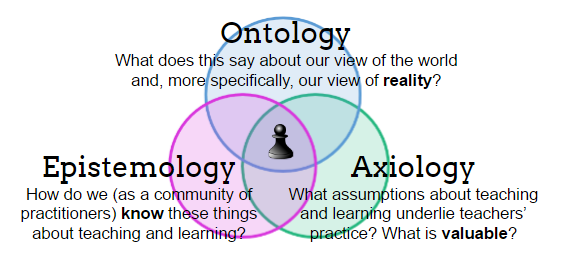
Ontology, Axiology and Epistemology
Ontology, axiology and epistemology are important related concepts in philosophy.
Ontology originally referred to the branch of metaphysics dealing with the nature of being and reality. In short, ontology refers to our ideas of reality and how it is constituted.
Epistemology, in turn, is interested in how we can acquire knowledge about that reality. The Greek word, ‘episteme’, refers to knowledge. Epistemologists try to identify the essential, defining components of knowledge. Thus, both of these provide a basis for learning and teaching, and they appear in learning theories. Equally, what we understand by learning and teaching leads to ontological and epistemological assumptions.
In addition to ontology and epistemology, there is a third concept of axiology that relates to value theories. It considers the values related to both ontology and epistemology. In its broad sense in the context of ontology, it addresses questions such as what is considered valuable in our world and our existence in it. The ideas educational systems adopt reflect what society regards as valuable for its success and welfare. (Audi, 1995)
Kent Lofgren's video "What is epistemology? Introduction to the word and the concept", which we view in class, defines epistemology as the study of knowledge, and contrasts empiricism (based on experience and observation) and rationalism (based on reason and logic). He also compares formal, genetic and social epistemology.
Of course 'Western' views of epistemology are not the only perspectives. “While Western science and education tend to emphasise compartmentalized knowledge which is often de-contextualized and taught in the detached setting of a classroom or laboratory, indigenous people have traditionally acquired their knowledge through direct experience in the natural world. For them, the particulars come to be understood in relation to the whole, and the ‘laws’ are continually tested in the context of everyday survival.” (Barnhardt & Kawagley, 2005).
Philosophy of Education
If you want, you can read http://plato.stanford.edu/entries/education-philosophy/ and reflect on your own teaching practice and personal views on the Philosophy of Education and Knowledge. 
Purpose of Education
Gert Biesta helps us to a wider view of education by focusing on the question of purpose – putting the ‘why’ of education before the ‘how’. He suggests these three broad domains of educational purpose:

The purpose of Maori education
In February 2001 the first Hui Taumata Mātauranga provided a framework for considering Māori aspirations for education. It resulted in 107 recommendations based around the family, Māori language and custom, quality in education, Māori participation in the education sector and the purpose of education. There was also wide agreement about three goals for Māori education:
  • to live as Māori
  • to actively participate as citizens of the world
  • to enjoy good health and a high standard of living
(Durie, 2004).
References
Audi, R. (gen. ed.) (1995), The Cambridge Dictionary of Philosophy, Cambridge: Cambridge University Press.
Barnhardt, R. & Kawagley, A.(2005). Indigenous Knowledge Systems and Alaska Native Ways of Knowing, Anthropology and Education Quarterly 36(1):8–23.
Durie, M. (2004). Māori achievement: Anticipating the learning environment. Hui Taumata lV: Increasing Success for rangatahi in education. Insight, reflection and learning. Palmerston North, NZ: Massey University.

Robinson, K. (2009) The Element: How Finding Your Passion Changes Everything. Penguin.
Thought Leadership
Are you ready to be the “go to” leader in your school or community? Do you want to have influence for positive change, have an impact in arenas that matter to you, and leave a legacy of consequence? Then you’re probably eager to get started on your journey towards thought leadership.
Thought leaders are the informed opinion leaders and the go-to people in their field of expertise. They are trusted sources who move and inspire people with innovative ideas; turn ideas into reality, and know and show how to replicate their success. Who are the online leaders you follow? Remember that there is nothing to stop a New Zealand teacher being and international thought leaders. Take Richard Wells for example: http://eduwells.com
Are you a thought leader?
We are hoping that during this course you'll do some critical reflection through consciously interrogating your own experiences and preconceptions about leadership. As a social construct, leadership is open to reconstruction and reconfiguration, therefore it is essential to keep exploring the meaning of leadership to open up and develop new ways of understanding. 
Clark (2012) suggests the concept of catalytic leadership, whereby your ability to bring about and inspire change is not dependent on a position of power. It is clear that even if a teacher is not in a position of authority they are in a position of influence, and it is this influence that is crucial to becoming a change agent and leading practice.
Followership
Traditional research in leadership has largely relegated followers to the role of passive recipients or, at best, moderators of leader influence and behaviors. However, recent work in the area of followership has begun shifting this focus and emphasizing the possibility that followers actively have an influence over leaders, in particular leader behavior. What do you think makes a good follower?
There is a growing body of work  that makes clear that some followers can be more influential than others. For instance, Carsten et al. (2010) argue that while some followers may proactively challenge a leader's assumptions and provide information and feedback without being asked to do so, others may voice their opinions to their leaders without challenging them, and still others may follow their leaders and execute their orders without question. This suggests that proactive followers, who voluntarily become a part of decision making and challenge leader decisions or behaviors, should have more influence on leaders than passive or simply active followers. See also Kelley (1988).
Why reflect on a blog?
Experience alone does not add value to life, or your practice. It’s not necessarily the experience that is valuable; it’s the insight you get because of your experience. Reflective thinking turns experience into insights! (Maxwell, 2009)
I can see a day in the not too distant future (if it’s not already here) where your “digital footprint” will carry far more weight than anything you might include in a resume or CV. (Betcher, 2009)
If you need help setting up your optional reflective blog
  • Ask help from your peers or even your students
  • Start small
    • Your Blog can be a Private or Public one
  • Remember that you can choose any platform
    • Blogger might be easiest (linked to your Google account)
    • Wordpress, Weebly and Wix have been used a lot too
    • It can be even just (for example a Google Site, OneNote) notes about your reflections
At next week’s session (first 15 minutes) we’ll help each other to set up blogs if needed. We'll also talk about the Assessments on next week's session. You’ll get all the information then. The first Assessment will be a video. So check what video editing tools and programmes you have on your devices and learn to use them. We’ll be making videos during the upcoming weeks, so use that time to upskill together.
References
Betcher, C. (2009). Digital footprints. Retrieved from http://chrisbetcher.com/tag/digitalfootprint/
Carsten, M. K., Uhl-Bien, M., West, B. J., Patera, J. L., & McGregor, R. (2010). Exploring social constructions of followership: A qualitative study. The Leadership Quarterly, 21, 543–562.
Clark, R. (2012). "I've Never Thought of Myself as a Leader But": The Early Years Professional and Catalytic Leadership. European Early Childhood Education Research Journal,20(3), 391-401.
Kelley, R. (1988). In praise of followers. Harvard Business Review, 66(6), 142–148.
Maxwell, J. C. (2009). How successful people think: Change your thinking, change your life. Hachette UK.
Day 1

What is Knowledge?
Discussion
Is knowledge shared or passed on
- dynamic - constantly changing
- is it dependent on environment?
- is everything i have experienced knowledge or do i have to be able to have a discussion and pass on?
- diff types of knowledge dependant on personality or attitude towards knowledge by person or other around them
- h
- to fuel a child's desire to exist in the world in an adult way.